Article
February 5th, 2026
Pilates gains popularity: The choice for the body and mind of contemporary people
Pilates gains popularity: The choice for the body and mind of contemporary people
When one opens social platforms, one can see the light and shadow check-ins at Pilates classes, as well as the astonishing comparisons of post-workout body postures everywhere. When entering communities and office buildings, more and more Pilates studios are quietly taking root and spreading warmth.
From the shining stars and supermodels to the busy office workers; from the postpartum mothers in urgent need of recovery to the elderly who pay attention to health care, more and more people actively enter the world of Pilates, making this sport, which centers on “control and balance”, break out of the niche fitness circle and become a new health trend sweeping the entire nation.
The popularity of Pilates is not accidental; it is the inevitable result of the upgrading of contemporary people’s health needs, the iteration of sports concepts, and the innovative development of the industry. What it carries has long gone beyond the sport itself and has become an important carrier for people to combat sub-health, relieve anxiety, and embrace a high-quality life.
Core appeal: Gentle and efficient, directly addressing the health concerns of contemporary people
The core appeal of Pilates lies in its precise alignment with the contemporary health demands of “gentle and efficient, nurturing both body and mind”. It completely breaks the conventional perception of fitness as “high-intensity and high-injury”.
Unlike the strength training in gyms that focuses on muscle dimensions, or yoga that emphasizes flexibility and meditation, Pilates is based on the core principles of “core control, breathing coordination, and precise exertion”. It focuses on activating the deep small muscle groups in the body, like creating a “natural protective belt” for the body, firmly supporting the spine and stabilizing the trunk. This fundamentally resolves various health problems caused by modern life.
For office workers who spend long hours sitting
Rounded shoulders, stiff necks, and back and waist pain have become the norm. Pilates, through a series of targeted movements, relaxes tense muscles, awakens weak muscles, and can not only gradually correct bad postures but also effectively relieve physical and mental fatigue caused by prolonged sitting, making a straight posture a habit ingrained in their bones.
For postpartum mothers
Its gentle core activation training can scientifically repair diastasis recti abdominis and pelvic floor muscle relaxation, and is recognized as the preferred method for postpartum rehabilitation in the industry.
For middle-aged and elderly people
Its low-impact feature is particularly friendly to the knees and lumbar spine. It can strengthen muscle strength, improve balance ability, effectively prevent the risk of falls, and improve joint flexibility, providing health protection for their later years.
Even professional sports enthusiasts
Often incorporate Pilates as cross-training to enhance core stability and reduce injuries from other sports.
Dual value: Beyond shaping, it also understands the contemporary people's physical and mental healing
What is even more remarkable is that Pilates achieves the dual value of “body shaping and healing”, precisely hitting the deep pursuit of “physical and mental balance” by contemporary people.
In the fast-paced and high-pressure present, people not only have to deal with fierce competition in the workplace and the complexity of daily life, but also confront inner anxiety and restlessness. However, Pilates precisely provides a dedicated space for “gentle dialogue with oneself”.
It requires that every movement be in sync with the depth of breathing. During inhalation, one relaxes the body and accepts oneself; during exhalation, one tightens the core and releases stress. In each inhalation and exhalation, one fully focuses on the subtle sensations of the body, clears the mind of distractions, and quietly enters a peaceful “flow state”.
This immersive experience has become an important outlet for contemporary people to relieve stress and release emotions. Studies show that long-term adherence to Pilates training not only shapes a firm and slender body with smooth lines, but also regulates the nervous system, improves sleep quality, and gradually relaxes the tired body and mind from a tense state, restoring vitality.
Compared to the quick-fix fitness that focuses on short-term sweat and fat burning, Pilates is more in line with “long-termism”. It does not promise immediate changes but can, through daily persistence, make the body stronger and the mindset more peaceful. This “slow-down health” is precisely the most scarce and most desired nourishment for the hurried contemporary people.
Scene Innovation: Breaking Barriers, Making Pilates Accessible to Everyone
The widespread popularity of Pilates cannot be achieved without the continuous innovation and expansion of the industry and the continuous expansion of its application scenarios. This once somewhat “exclusive” sport has shaken off the labels of “high threshold” and “limited scenarios”, becoming accessible to everyone and something that anyone can practice.
Tracing its origin, Pilates was founded by Joseph Pilates in the 1920s. Initially, it was used to help dancers and athletes recover from surgery and improve their physical fitness. Later, it gradually spread to Europe and America and became a popular body shaping secret among celebrities and influential figures.
In 2003, Pilates was officially introduced to China. Initially, it existed only in high-end fitness venues as a “rare sport”, but gradually entered the homes of ordinary people. This transformation was made possible through continuous innovation and deep exploration on the supply side.
In terms of scene layout, the industry broke away from the “large store model” of traditional commercial complexes, precisely setting up community mini studios and convenient venues in office buildings, creating a “15-minute fitness commuting circle”, allowing people to easily start a Pilates journey during their lunch breaks or after work using fragmented time.
At the same time, innovative scenarios such as “parent-child Pilates”, “outdoor lawn Pilates”, and “micro courses for workplace breaks” have emerged continuously, precisely matching the individualized needs of different groups, integrating Pilates into every corner of life.
In the online domain, a three-dimensional teaching matrix of “live interactive classes + recorded customized classes + AI personal training guidance” has been formed. Combined with portable equipment such as folding Pilates beds and Pilates rings, people can enjoy professional and systematic Pilates training without leaving their homes, completely breaking free from the constraints of time and space.
Scene Innovation: Breaking Barriers, Making Pilates Accessible to Everyone
In terms of professionalism, the Pilates industry is also continuously standardizing and refining its development, ensuring that every practitioner can exercise safely, scientifically, and efficiently.
The once prevalent chaos of “obtaining a certificate and then starting work” among instructors has gradually dissipated. With the official implementation of the “Pilates Coach Professional Skill Level Standards”, Pilates coaches must pass rigorous theoretical examinations, practical certifications, as well as specialized training in areas such as pregnancy and rehabilitation, before they can obtain their certificates and start working. The proportion of certified instructors in the industry has significantly increased, and the quality of instructors has notably improved.
At the same time, the service provided by venues has also become more refined and personalized. From the 3D body posture scanning assessment upon entering the venue to accurately identifying physical pain points and weaknesses; to real-time movement correction during classes, patient guidance on every forceful detail; to dietary suggestions and sleep guidance after classes, forming a “exercise + life” full-closure service, every practitioner can receive a personalized training plan tailored to them.
Furthermore, the integration of intelligent technology and green concepts has given Pilates a new lease of life and vitality – intelligent mirrors equipped with AI motion recognition can capture motion deviations in real time and promptly correct them; wearable devices can be linked to the courses to precisely adjust the training intensity and rhythm; more and more venues are using environmentally friendly materials for decoration and using degradable training consumables, which not only safeguard the health of practitioners but also align with the contemporary people’s consumption concept of “low-carbon, environmental protection, and green living”.
Empowering dissemination: Universal applicability, igniting a trend of fashionable fitness
Social dissemination and its adaptability to the entire population further promoted the popularity of Pilates, upgrading it from a mere “exercise program” to a fashionable and healthy “lifestyle”.
On social platforms, celebrities and fitness bloggers frequently share their daily Pilates training experiences: Ma Long’s wife Xia Lu successfully regained a firm figure after giving birth through Pilates, and the Kardashian sisters, Jennifer Lopez, and other Hollywood stars have been persistently practicing Pilates and using their own experiences to prove its dual value of shaping and healing.
These shares not only showcase the unique charm of Pilates but also lead the fashion trend of national fitness.
At the same time, the real body posture comparisons and sincere training insights of ordinary users have also formed a powerful word-of-mouth effect, allowing more people to see the practical value of Pilates and actively join the practice.
What’s more noteworthy is that the “full population adaptability” of Pilates has enabled it to have a wide audience base: teenagers practicing Pilates can improve their body posture and prevent myopia, while working professionals practicing it can counteract the harm of prolonged sitting and relieve shoulder and neck pressure; postpartum mothers practicing it can scientifically recover and reshape their body posture; middle-aged and elderly people practicing it can maintain joints and enhance physical fitness; and sports enthusiasts practicing it can improve core strength and reduce sports injuries.
This “unrestricted by age, physical condition, or foundation” universality has enabled Pilates to completely break away from the stereotype of being “exclusive to women”, becoming a healthy choice for all populations.
Deep Core: The Changes in Consumption Logic Behind the Rise of Pilates
Today, the popularity of Pilates has gone far beyond the sport itself. Behind this phenomenon lies a profound transformation in the health consumption logic of contemporary people – from “passive treatment” to “active health management”, from “seeking superficial shaping” to “emphasizing deep physical and mental nourishment”, and from “single exercise” to “synergistic development of body and mind”.
According to data, the market size of Pilates in China has exceeded 35 billion yuan by 2025, with a compound annual growth rate far exceeding the global average. Behind these impressive figures is the pursuit of a better life by more and more people and their appreciation for physical and mental health.
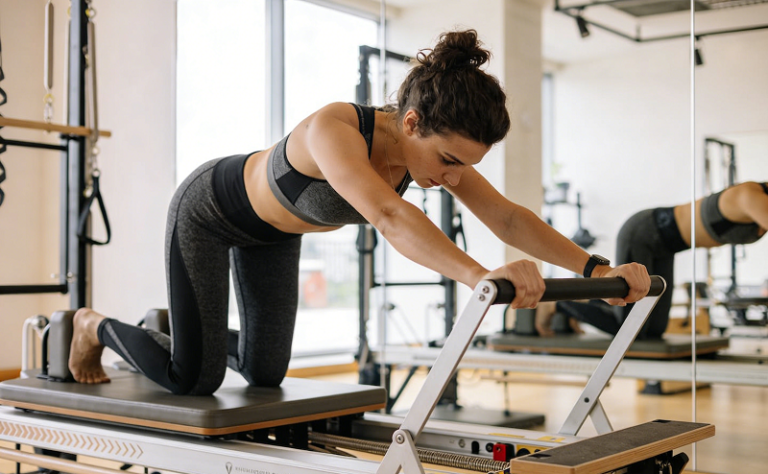
Conclusion: Choosing Pilates means choosing an attitude of loving life
Choosing Pilates is never about blindly following trends or chasing fashions. Instead, it is about choosing a lifestyle attitude of “being responsible for oneself and loving life”.
It does not require a strong physical foundation or expensive investment. All you need is a mat and perseverance. Through each precise control and each coordinated breathing, you can encounter a more upright, stronger, more peaceful, and more beautiful self.
When fitness is no longer a burdensome task and healing integrates into the little details of daily life, Pilates is no longer just an exercise. It has become a way for contemporary people to combat anxiety, safeguard health, and embrace life. This is precisely the core reason why it continues to be popular and gains more and more people’s love.