June 18, 2026
How to Identify a Superior Pilates Reformer
In the Pilates industry, devices are not only a tool, but also the core of studio assets.
A mediocre device may perform well in the first three months after purchase, but in high-frequency business teaching, three months later is the real test.
As experts on the manufacturing side, we do not talk about the sense of empty design.
Starting with mechanics, materials and operational logic, we teach you how to disassemble a truly excellent Pilates core bed (Reformer) through the following five core dimensions.
I.The Springs: Linear Resistance and Life Cycle
The spring is the soul of the core bed.The judgment of merit and demerit is not the magnitude of the resistance, but the linearity of the resistance.
Practical judgment: During the stretching process, the increase in resistance of an excellent spring should be uniform and smooth.
If the stretch is suddenly stiffened to the end, the design of the elastic range is unreasonable.
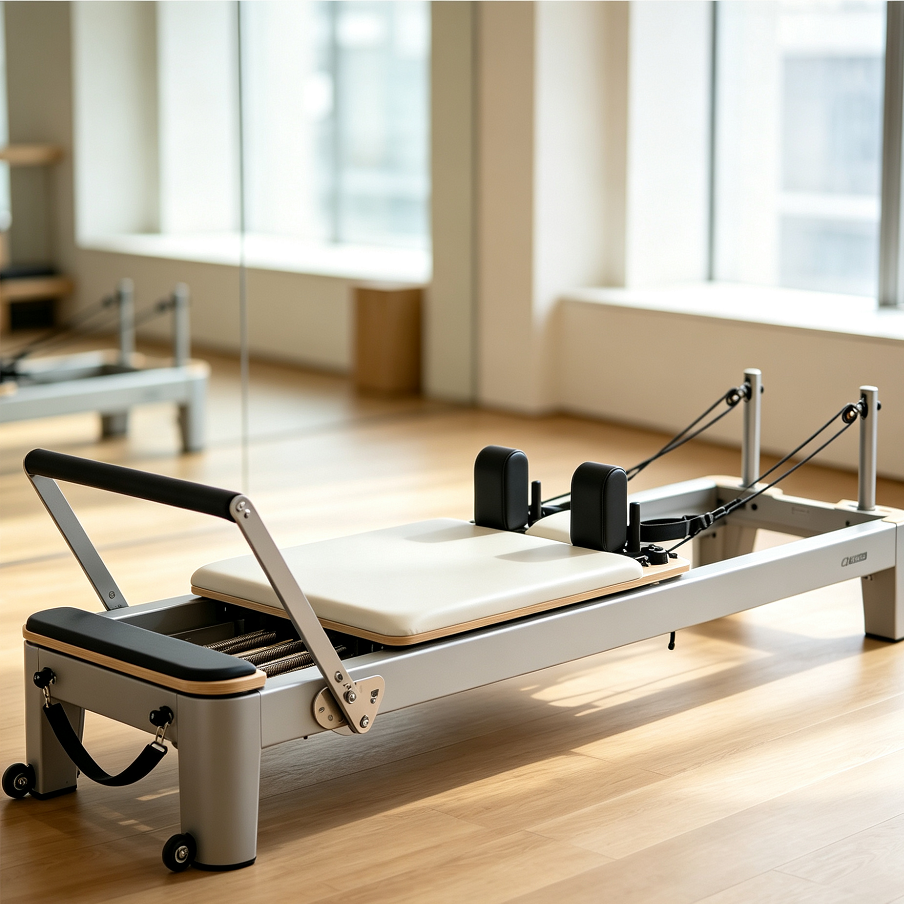
Material standards: Excellent instruments should use high quality piano wires or high-performance alloy steels that have undergone precision heat treatment.
Safety detail: Observe the hooks of the springs.High-quality springs should have a noise-proof jacket at the hook, and the surface of the spring should be uniformly coated (such as nickel plating or Dacromet process) to ensure that there is no rust and abnormal noise in a high humidity (sweat erosion) environment.
Factory data: Ask the supplier about the “number of fatigue tests” of the spring.
Commercial grade springs should be able to withstand at least 300,000 non-destructive stretches.
II. Carriage System: Silence and Precision Engineering
The sliding experience of the skateboard (Carriage) determines the “advanced feel” of the Pilates practice.
Pulley bearings: Excellent beds should use sealed bearings or industrial grade polyurethane pulleys.
This material not only guarantees a very low coefficient of friction, but also absorbs vibrations.
Tolerance control: Try shaking the skateboard sideways.
The fit tolerance of an excellent bed between the guide rail and the pulley should be controlled at 0.1mm-0.2mm.
If the shaking amplitude is too large, it will not only produce noise, but also lead to long-term structural wear.
Silence test: No-load pushes the skateboard to hear if there is metal friction.
Good instruments should only have a slight “rustling” sound when the wheels are rolling.
III. The Frame: Static Load and Torsional Stiffness
Whether it is a wooden or aluminum frame, the core is the stability of its load-bearing.
Wooden frame: Hard North American Maple or Oak is preferred.
The key is the timber.
Moisture content control.
Excellent factories are subjected to constant temperature drying for 15-30 days to prevent cracking or deformation of wooden frames in different countries, such as extremely dry North America or wet Southeast Asia.
Aluminum frame: Aviation grade 6061-T6 aluminum shall be used.
Observe whether the solder joints or joints have been reinforced.
The law of weight: within a certain range, the more stable the bed represents the better stability.
A good Pro core bed usually weighs no less than 100kg to ensure that the bed is not displaced during difficult standing exercises such as Standing Splits.
IV. Upholstery: Grip, Durability, and High-Density Support
This is where users are most physically exposed and where wear and tear is fastest.
Leather (PU/PVC): Good leather must be “sticky” (good grip to prevent slippage after sweating) and Crack resistance.
Commercial grade leather should pass at least 50,000 Martindale Tests.
Foam: Never use ordinary sponges that are soft and collapsed.
The criterion is “high density rebound”.
Excellent floor sponge density should be between 40-60kg/m ³.
It must provide sufficient support to ensure that the spine is not pressed directly against the plank below during long-distance spinal training.
V. Adjustment System: Intuitive Design and Efficiency
In a commercial studio, time is money.
The teacher needs to adjust the instrument settings for the next set of actions within 10 seconds.
Footbar: Is the adjustment smooth?
Is there a safety locking mechanism to prevent accidental touching?
Gear Bar: Is it possible to quickly adjust the starting position of the spring without removing the parts?
Rope System: Is there a Cleat system?
Good equipment shouldn’t make teachers waste time on knots.
Excellence Lies in the Details You Can't See
An excellent Pilates core bed, 30% of its value lies in the appearance, 70% is hidden in the invisible interior: the grade of the bearing, the moisture content of the wood, the fatigue test data of the spring.
We advise our B-end customers not to just look at a beautiful sample diagram when choosing a supplier.
Request test reports and production tolerance standards for core components from the supplier.
Because in commercial operations, durability is the biggest cost savings, and expertise is the strongest customer stickiness.